
Every big moment has a sky.
Your wedding night, a first home, the night someone arrived. Pick a moment and a place, and we draw the real sky above it, right here in your browser.
Drag · pinch · tap a star
Drag to look around. Pinch, or hold Ctrl or Cmd and scroll, to zoom.
Want a guide who explains your sky every day?
What a star map shows
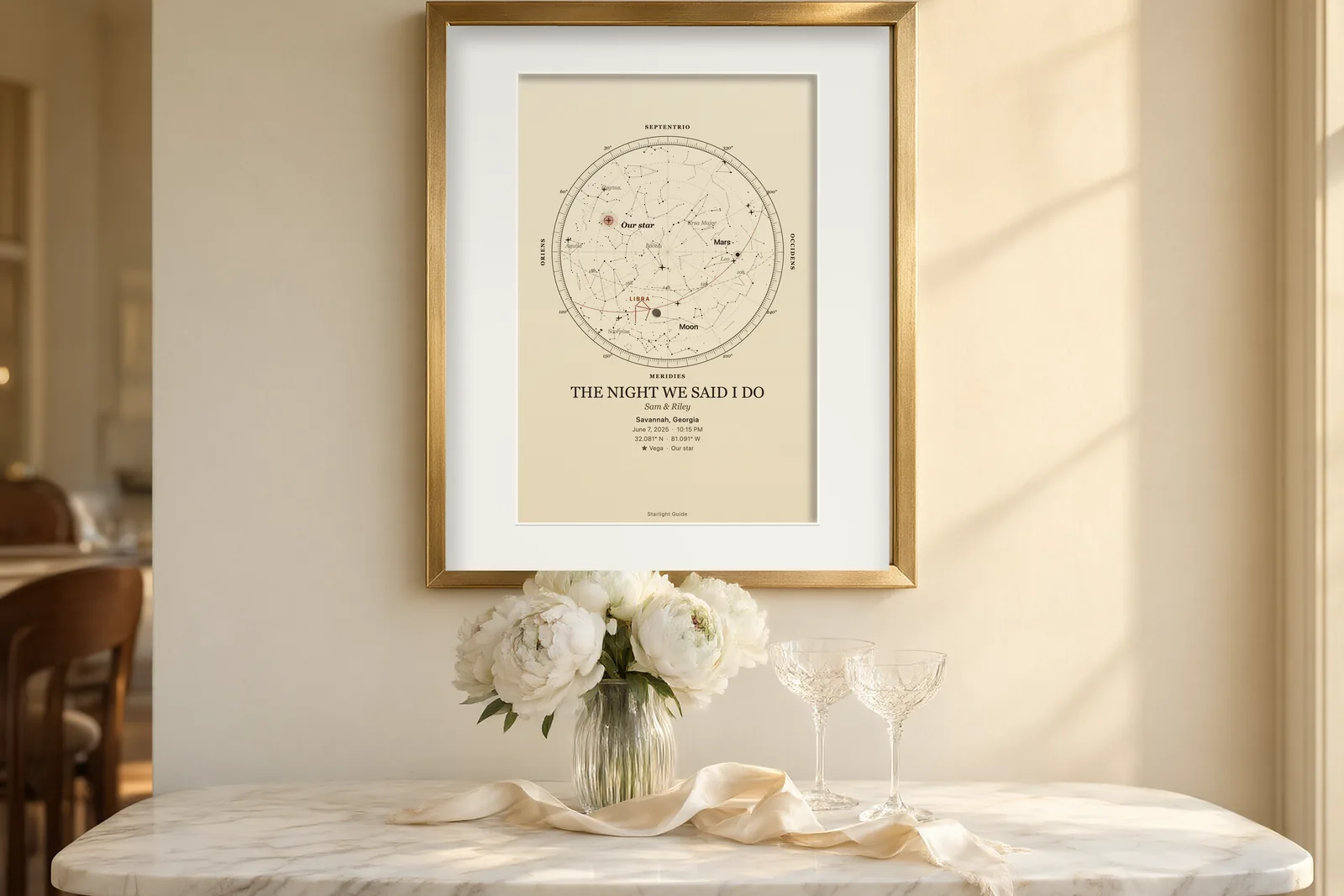
A star map is a picture of the real night sky above one place at one moment. Pick a date, a time and a city, and the map draws the stars that were overhead: the constellations, the Moon and its phase, and the planets above the horizon. It is drawn from astronomical calculations, not from an illustration, so the same moment looks different from two different cities.
How it works
- Choose the moment. Enter a date and, if you know it, a time. With no time the map uses noon by the local clock and tells you so.
- Choose a place. Start typing a city and pick it from the list. The sky shifts with latitude, so the place matters.
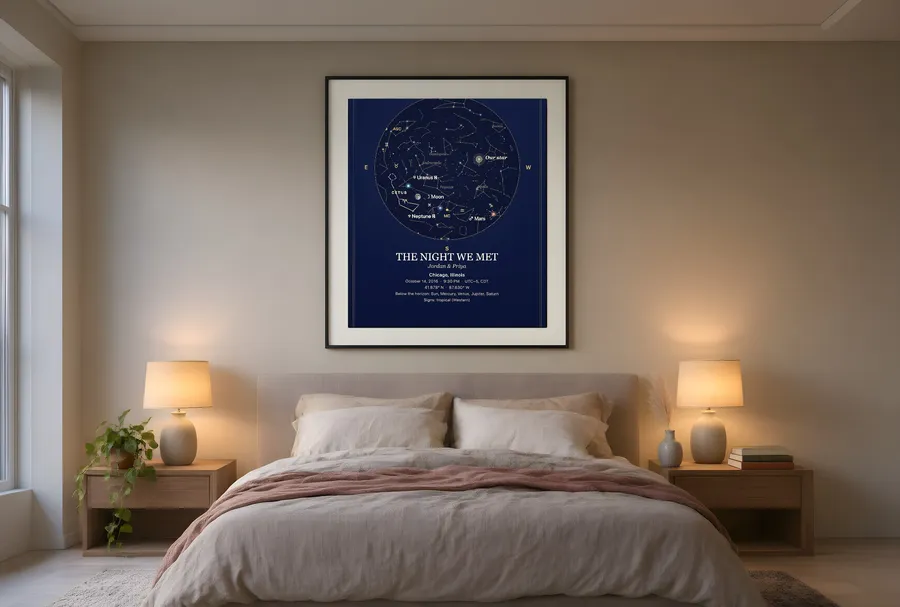
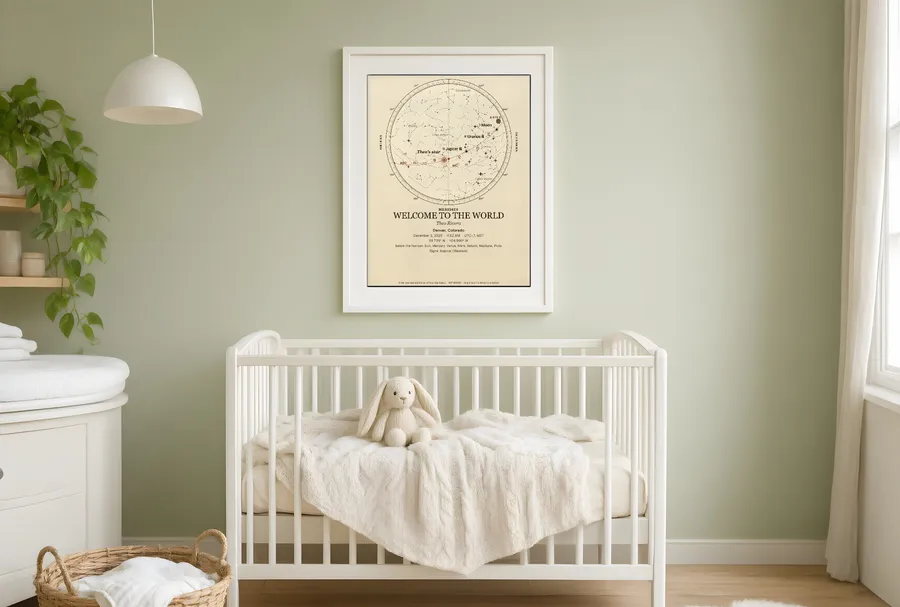
- Choose a style. Midnight atlas, Painted horizon, Celestial plate or Galaxy: the same sky, framed four different ways.
- Add your words. A title, names, a short line of your own and a featured star. Then save an image for your screen, or have a printable version made through our Etsy shop.
Good to know
- Everything is computed in your browser. Nothing you enter into the map is sent or stored.
- Stars are drawn as if the sky were dark, so a daytime moment shows the Sun among them.
- Positions are astronomical facts for the date, time and place you give. They are not a prediction.
Moments people choose
A wedding or an anniversary, a graduation, the night a baby arrived, the first night in a new home, or simply the night you were born. Browse the ideas for weddings, anniversaries, new babies, your own birth night and gifts. New to the sky? Astrology 101 with Sage explains the basics in plain language.
Credits
Stars: XHIP (Anderson & Francis, 2012), from ESA's Hipparcos mission, and constellation figures, via d3-celestial (BSD-3, Olaf Frohn). Sun, Moon and planets: Astronomy Engine (MIT, Don Cross). Sidereal offset: precomputed with the Swiss Ephemeris (Astrodienst). Moon texture: NASA's Scientific Visualization Studio. Milky Way: drawn from galactic coordinates (no dataset). Cities: GeoNames (CC BY 4.0). Time zones: IANA tzdb 2026e. Type: Cormorant Garamond and Jost (SIL Open Font License).